RevOps Tech Stack Assessment
A RevOps tech stack assessment is a fixed-price audit of every system your revenue team runs on: CRM, marketing automation, forms, website, integrations and reporting, assessed together rather than one at a time.
Growth Geyser reviews each tool, maps how data actually moves between them, and hands you a prioritized list of fixes with an hour estimate on each.
You find out what is in your stack before you spend money changing it.
Fixed price. Full refund within 30 days. Starts within 48 hours of payment.
What we look at
This is a full tech stack audit. Where our Deep Dive audits a single CRM, this assessment covers every tool in the stack and how they connect.
CRM
Email & marketing automation
ActiveCampaign, Mailchimp, Klaviyo, Keap
Forms & landing pages
Jotform, Gravity Forms, Unbounce
Website & ecommerce
WordPress, Webflow, Shopify, WooCommerce
Integrations & middleware
Zapier, webhooks, direct API connections
Support & chat
Zendesk, Freshdesk, Intercom
Outbound
Instantly, Reply.io, Woodpecker
Analytics & reporting
GA4, Google Tag Manager, Looker Studio
Another platform in the middle of your stack? Ask us.
Why You Need a RevOps Tech Stack Assessment
Most revenue teams did not design their stack. It accumulated, one tool at a time.
Is there one system that has every single person in it?
On most stacks, there isn't. Contacts live partly in the CRM, partly in the email platform, partly in a spreadsheet, and every report depends on which one you open.
It usually shows up like this
The assessment answers five questions
- What is actually in each system?
- Are you using what you pay for?
- Does data move between your tools the way everyone assumes it does?
- Can your reports be trusted?
- What should be fixed first, and what will it cost?
In clients' words
“We have two systems that don't talk... I think it is a huge problem.”
“I would love one spot to track everything.”
“We need a full audit. We don't know what the heck is going on in there.”
“People are disconnected, data flows disconnected.”
What a simpler stack buys you
Fewer points of failure
Every connection between two tools is one more thing that can break without anyone noticing.
It scales
Growing from a small core of tools is easier than growing a tangle of them.
Your team actually uses it
When a CRM is too complicated, salespeople quietly go back to spreadsheets.
Lower cost
Fewer subscriptions, and more out of the ones you keep.
The assessment: a fixed-price audit of your whole revenue stack
Before you spend money changing your systems, find out what is actually in them. The RevOps Tech Stack Assessment audits every tool your revenue team runs on, delivered as three written documents plus two calls. It is a self-contained purchase. Nothing about it obligates you to hire us for the work it recommends.
RevOps Tech Stack Assessment
Your whole stack: CRM, marketing automation, forms, website, integrations and reporting.
You get three documents
- 1A technical audit of the whole stackEvery tool in it, not just the CRM: automations, lists, fields, pipelines, forms, integrations and tracking, reviewed one at a time and linked so you can click straight to each. Not a summary of themes.
- 2A map of how your systems actually pass dataYour choice of a tech stack data map, a sales journey with pipeline stages, or a marketing email journey. Connections we confirmed are drawn differently from the ones people assume exist, because on most stacks those are two different diagrams.
- 3Prioritized recommendations, with hoursUsually six to twelve projects in priority order, an hour range on each and on the total, and the dependency order between them stated plainly. Cut any you do not want. Reporting comes last on purpose: fix the data first, or the dashboards report bad numbers. This is the document you would hand to us, to your own team, or to another vendor.
How it runs
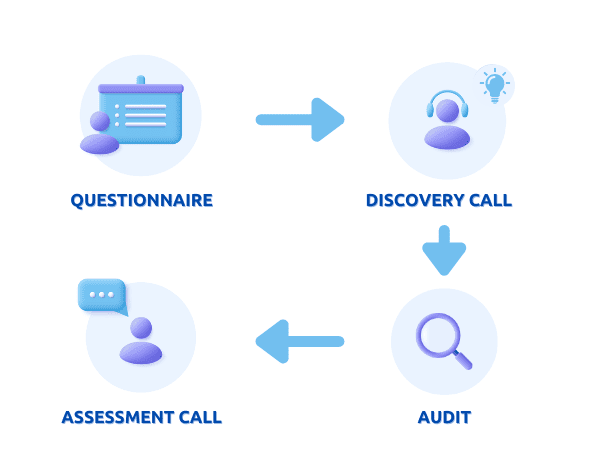
Step 1: Questionnaire
We build a questionnaire around your stack, not a template. It usually takes 30 to 45 minutes to answer.
Step 2: Discovery Call
Two hours on Zoom. Your answers, your pain points, and a walk through your actual processes.
Step 3: Audit / Deeper Dive
You grant admin and API access, and we audit. Access is a requirement, not a preference: our tooling reads each account through the platform's API, so everything is pulled and counted, not sampled by hand.
Step 4: Assessment Call
You get the three documents, then 60 minutes on the findings, best practices and the priority list, with room to argue with it.
Access
Admin + API access to each tool audited. Granted after the discovery call, revocable on delivery.
Start
Within 48 hours of payment.
Payment
Due in advance.
Guarantee
Full refund within 30 days if you did not gain real insight. No questions asked.
What happens after. If you want us to build what the recommendations describe, buy a block of hours or ask for a fixed-rate quote. If you would rather take the documents elsewhere, they are yours. There is no upsell built into the deliverable.
When to skip it. If you already know the one or two things that are broken, you do not need an assessment. Buy a block of hours instead: we diagnose in the first few hours and go straight to fixing.
Or book a free discovery call first if you would rather talk it through.
Only need one CRM audited? See the Deep Dive, same price.
A recent stack assessment, in brief
A wealth-management firm growing fast had its contacts split across three systems: its CRM of record, its email platform, and an advisor workflow tool. None of the three had everyone in it.
The assessment's top recommendation was not a new tool. It was cleaning out the email platform they already paid for, so the rest could be built on data they trusted.
What a recent single-platform audit turned up
From a Deep Dive, the one-CRM version of this audit. The same technical audit runs on every tool in your stack here. One engagement: 72 automations, 65 lists, 85 tags, 277 campaigns and 16 forms, each reviewed individually. Client anonymized. The counts are exact because they came out of the API, not a manual click-through.
- An automation had tagged 11,595 people. The one waiting downstream listened for that tag spelled slightly differently, so it had never fired once.
- A course-completion email triggers correctly every time and points at a campaign still sitting in Draft, so it has never delivered.
- $13.6M of placeholder deal value across 1,780 deals, inflating every sales report that read from it.
- 26 lists with zero subscribers and 24 tags on zero contacts, and no master list, so a contact could unsubscribe from one list and keep receiving mail from the other 64.
- A 2022 automation still actively texting customers. Nobody on the team knew it was running.
Frequently asked questions
What is a RevOps tech stack assessment?+−
A RevOps tech stack assessment is a fixed-price audit of the CRM, marketing automation and connected tools a revenue team runs on. Growth Geyser's assessment produces a technical audit, a map of how data moves between systems, and a prioritized list of fixes with hour estimates.
What is the difference between a tech stack audit and a CRM audit?+−
A CRM audit reviews one platform. A tech stack audit, sometimes called a martech stack audit, reviews every tool the revenue team uses and how data moves between them. Growth Geyser sells both at the same fixed price: the Deep Dive for a single CRM, and the RevOps Tech Stack Assessment for the whole stack.
How much does the RevOps Tech Stack Assessment cost?+−
Growth Geyser's RevOps Tech Stack Assessment is $1,450, one time, with a full refund within 30 days if you did not gain real insight.
How long does it take?+−
The assessment starts within 48 hours of payment. A small, tidy stack can finish within a week of the discovery call; a large one with several hundred automations takes longer.
What access do you need?+−
Admin and API access to the tools being audited, granted after the discovery call and revocable as soon as the audit is delivered.
Do I have to hire Growth Geyser to implement the recommendations?+−
No. The assessment is a self-contained purchase. The recommendations are written so your own team or another vendor can act on them.
What if we only need one thing fixed?+−
Then skip the assessment. If you already know the one or two problems, buy a block of hours and Growth Geyser diagnoses and fixes them directly. The assessment is for when you do not know what you do not know.
Will you tell us to buy more software?+−
Usually the opposite. Growth Geyser's aim is the smallest set of tools that does the job: fewer connections to break, less to pay for, and a system the team actually uses.